


Meta Description: Discover why manual cartoning erodes profit margins at scale, how automated laundry sheet packaging equipment transforms unit economics, and the data-driven framework for calculating your cartoning automation ROI.
Most manufacturers operate under a straightforward assumption: when demand climbs, you add capacity — more machines, more floor space, more people — and profit follows. For a laundry sheet producer in the personal care segment, this logic triggered an expansion that looked sensible on paper. New production equipment was commissioned, additional warehouse square footage was leased, and twelve workers joined the payroll, with ten assigned specifically to the cartoning station where finished laundry sheets are inserted into retail cartons and sealed.
Sixty days after the expansion went live, the monthly P&L review delivered a result that contradicted every assumption behind the investment. Unit output had risen. Top-line revenue tracked higher. But net profit sat nearly flat — and two product SKUs actually recorded margin contraction. The capital expenditure and facility lease had been modeled in advance. What slipped past the projections was the compounding effect of packaging labor.
The ten workers added to cartoning were consuming virtually all the incremental margin that the production increase should have delivered. The per-unit packaging cost had expanded at a rate that the volume growth could not absorb. This is not an isolated anomaly. It is a structural pattern that repeats across laundry care manufacturing operations once manual cartoning passes a certain throughput threshold — and it explains why so many mid-to-high volume producers eventually face the same uncomfortable question: why is getting bigger not making us more profitable?

The Structural Problem With Manual Cartoning at Scale
Cartoning looks deceptively simple when observed at low volumes. One person extracts a flat blank from the stack, erects the carton, loads the predetermined number of laundry sheets, closes the flaps, applies the seal, and transfers the finished unit to outbound staging. The sequence is linear and manageable.
The difficulty surfaces when volume demands more than one or two people can deliver. At that inflection point, manual cartoning reveals four structural cost drivers that compound faster than revenue:
1.Diminishing throughput per additional worker. Each new person added to a manual cartoning station contributes less incremental output than the previous one. Coordination friction, shared workspace constraints, and the need for supervision grow with headcount, meaning the tenth worker on the line delivers materially less marginal productivity than the third.
2.Speed-induced quality degradation. When production schedules put pressure on a manual team, defect rates climb. Fold lines lose precision, seal adhesion becomes inconsistent, and product count accuracy drifts. Every defective carton that requires rework consumes labor that was supposed to go to new production — a hidden tax on effective throughput that gets masked in aggregate numbers.
3.Structural fragility from workforce dependence. A cartoning line depending on ten manual workers is one unplanned absence away from a throughput gap that no amount of overtime can fully close on the same day. Two absences simultaneously trigger a cascading shortfall. The operation’s output becomes a function not of equipment capacity but of attendance probability — a variable no production planner can control.
4.Floor space economics that undermine the P&L. Ten workers at packing stations occupy approximately 60 to 80 square meters of production floor. Lease or facility cost per square meter, multiplied across that footprint, adds a fixed monthly charge to the cartoning function. Equivalent automated equipment requires roughly 10 to 15 square meters for comparable or higher throughput, reducing the facility cost contribution per carton by a factor of four or more.
These four dynamics operate simultaneously, and they compound. The manufacturer that adds workers to solve a volume problem is effectively adding margin-eroding costs that grow in proportion to — and sometimes faster than — the revenue those workers support.

Industry Context: The Economics Are Shifting
The broader packaging machinery landscape provides useful context for the decision facing individual manufacturers. Global packaging equipment market value stood at approximately USD 48.5 billion in 2024, with projections indicating growth to roughly USD 68.4 billion by 2032, reflecting a compound annual rate of about 4.4%, according to market research published by USD Analytics. The growth is not being driven by marginal efficiency improvements — it reflects a structural shift in manufacturing economics, where rising labor costs, tightening delivery expectations, and quality consistency requirements make automated packaging the rational default for operations above a certain throughput level.
Industry data collected across multiple manufacturing segments shows that automated packaging systems reduce direct labor hours by approximately 35% to 42% per shift. Automated lines operate at roughly 97% runtime efficiency compared to approximately 74% for manual equivalents — meaning the machine delivers productive output for an additional 23 percentage points of every operating hour, according to packaging automation data compiled by Echo Machinery. When compensation, benefits, training, supervision overhead, and quality rework are fully accounted for, the per-unit labor cost of manual cartoning at mid-to-high volume typically exceeds automated alternatives by a factor that makes the capital investment recoverable within 12 to 24 months through direct labor savings alone.
The Automation Economics: What One Machine Actually Changes
The arithmetic that governs cartoning automation is straightforward but requires accounting for costs that manual operations often overlook. Here is how the economics restructure when a dedicated cartoning machine replaces manual stationing.
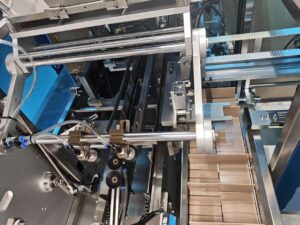
An automated cartoning system designed for laundry sheet applications performs three sequential operations without manual intervention at each step. Carton blanks stored in a magazine feed are automatically extracted and erected into position for loading. The laundry sheet product is then fed into the open carton through a verified counting mechanism that confirms correct quantity and orientation before the carton proceeds. Finally, the flaps are folded and sealed — using either tuck-end closure or hot-melt adhesive depending on carton specification — and the completed unit exits the line ready for case packing or palletizing.
The staffing model shifts from the ten-person manual crew to a configuration requiring one operator to monitor the machine’s performance and make minor adjustments, plus one support worker responsible for magazine replenishment and finished goods handling. Two people cover the throughput that previously demanded ten — and they do so at higher consistency, with lower defect rates, and without output variance driven by fatigue, training gaps, or absenteeism.
The Economics Recalculated
Consider a representative scenario: a laundry sheet manufacturer running one shift per day, five days per week, with a manual cartoning station staffed by ten workers at an average fully loaded compensation of USD 3,200 per person per month. The monthly packaging labor cost for cartoning alone is approximately USD 32,000.
After automation, the station operates with two people. The monthly cartoning labor cost drops to approximately USD 6,400. The gross monthly labor saving of roughly USD 25,600 flows directly to operating margin.
Against a cartoning machine capital outlay in the range of USD 80,000 to USD 120,000 — depending on configuration, carton format, and integration requirements — the payback calculation becomes mechanical. At USD 25,600 in monthly labor savings, the full investment recovers in 3.1 to 4.7 months from the labor reduction alone. This calculation excludes the additional margin contribution from the throughput increase, the reduction in rework and scrap costs, and the value of recovered floor space that can be repurposed for revenue-generating activity.
Over an operational lifespan of eight to ten years under standard maintenance protocols, the cumulative labor savings from automation represent a multiple of the original machine cost — typically in the range of 20 to 30 times the capital outlay when calculated over the full service life. The machine continues generating monthly margin improvement long after the balance sheet has fully amortized its acquisition cost.
Real-World Application: What Changed After Implementation
When the laundry sheet manufacturer referenced earlier deployed automated cartoning, the operational changes began appearing within the first production shift. The staffing reduction was immediate and permanent — ten workers displaced from cartoning duties, with two retained for machine operation and material handling. Total back-end packaging headcount across the facility declined by approximately 40%, as operator redeployment from other packaging functions became possible.
The throughput picture was equally unambiguous. Because the manual cartoning station had been the production line’s primary constraint — upstream manufacturing could produce faster than the packing team could clear — automating the bottleneck produced a system-level output gain of approximately 28% to 32%. The improvement came not from the machine running faster than ten people at peak speed but from its ability to sustain consistent throughput across every shift, every day, without the deceleration that manual operations experience due to fatigue, shift handover gaps, and attendance variability.
Defect rates at the cartoning station — previously running at approximately 2% to 4% due to the quality degradation that accompanies high-speed manual work — dropped below 0.5%. The rework labor that had been quietly consuming effective capacity disappeared, contributing additional throughput without any increase in staffing or operating hours.
The floor footprint formerly occupied by ten packing stations — roughly 65 square meters — was reduced to approximately 12 square meters for the automated system. The recovered 53 square meters was reallocated to inbound material staging, which streamlined the upstream material flow and removed a secondary bottleneck that the factory had not previously identified because it had been masked by the larger cartoning constraint.
The Financial Close
One full month after the cartoning machine entered production, the financial comparison validated the pre-purchase analysis. The labor cost line for packaging operations showed a reduction equivalent to approximately eight full-time workers. Combined with the throughput uplift and defect reduction, the monthly margin improvement placed the full investment recovery at roughly four and a half months from commissioning — confirming the pre-installation projections within days.
Decision Framework: Is Your Operation at the Automation Threshold?
The decision to automate cartoning is not binary — not every laundry sheet manufacturer should rush to purchase equipment — but the indicators that signal a positive ROI are consistent and measurable. If three or more of the following conditions describe your current operation, the economics of automation are likely already in your favor:
1.Your packaging headcount has grown in the last twelve months but net profit has not followed proportionally. The labor you added is consuming the margin the volume was supposed to generate.
2.Cartoning is the consistent bottleneck on your production floor. When upstream manufacturing regularly waits for the packing station to clear before running the next batch, cartoning is the throughput constraint.
3.You are declining orders or extending lead times because packing capacity cannot commit to the delivery window. Lost revenue from capacity constraints is invisible on the P&L but real — and automation converts that lost opportunity into captured revenue.
4.Buyer quality complaints reference packaging issues — inconsistent sealing, incorrect product count, carton damage. These complaints carry both the direct cost of returns or credits and the long-term cost of customer relationship erosion.
5.Your pricing quotes are built on current labor assumptions that you know will rise if you accept the order. Labor cost embedded in each quote becomes a liability when volume increases — because the labor cost per unit is what automation replaces.
What to Expect Before Making a Capital Decision
The purchase process for cartoning automation should begin with verification, not assumption. Reputable equipment providers offer a sample trial as a standard pre-sale step: you submit your actual laundry sheet product and carton specifications, and the supplier runs a live production test on the candidate machine, documenting the results on video for your review. You evaluate actual throughput speed, seal integrity, carton handling precision, and count accuracy — on your product, in your carton format — before any commitment is made.
For operations with non-standard carton dimensions, specialized closure requirements, or integration needs with existing upstream equipment, custom engineering configurations are typically available with documented delivery timelines. Standard configurations that match common carton formats frequently ship within a short window after contract finalization.
Layout planning should be part of the evaluation process. Equipment providers should supply floor plan options showing machine placement, operator access zones, material flow paths, and connection points to your existing production line — reducing the integration risk and allowing you to validate the footprint assumptions before installation begins.

The Long View
Twelve months after deployment, the manufacturer at the center of this analysis has accumulated consistent monthly savings, experienced zero unplanned downtime on the cartoning equipment, and recovered the full investment multiple times over through labor cost reduction alone. The operational director’s assessment is unambiguous: the monthly margin improvement generated by the machine exceeds the capital cost on an annualized basis, making the decision in retrospect not a close call but an obvious one.
For laundry sheet and laundry care manufacturers currently operating manual cartoning at mid-to-high daily volume — or planning a production expansion that will push cartoning throughput past the point where manual labor scales efficiently — the relevant calculation is not what the equipment costs. It is what the equipment saves, month after month, for as long as the production line operates. Over a decade of service, that figure is substantially larger than the purchase price. The arithmetic is straightforward to verify, and for most operations above a certain volume, it points clearly in one direction.
Post time: Jun-17-2026