


For pet food manufacturers and treat producers weighing their packaging line configuration, two primary paths emerge: automated cartoning systems that form, fill, and seal paperboard boxes, versus premade pouch filling lines that handle flexible stand-up bags. The decision carries implications far beyond the factory floor—it shapes how your product looks on shelves, what it costs to produce, how it survives distribution, and ultimately how consumers perceive your brand.
This article walks through the key dimensions of the cartoning-versus-pouch equation, helping you assess each format against your specific product profile, channel strategy, and growth ambitions.
A Closer Look at Each Packaging Approach
Automated Cartoning Lines
A carton folding machine takes flat, pre-scored paperboard blanks and mechanically erects them into rigid containers. Product flows into the formed carton, after which the top flaps close—either via tuck-in closure or hot glue sealing, depending on the line configuration. The finished unit is a sturdy, six-sided box with printable surfaces on every face. Most cartons use paperboard or lightweight corrugated stock and are readily accepted by municipal recycling streams.
Typical pet industry applications for cartoning equipment include: freeze-dried morsels, dry kibble portions, dental sticks, nutritional powders, grooming accessories, and toy bundles.
Premade Pouch Filling Systems
Premade pouches arrive at the filling station already constructed—stand-up formats, flat bags, or quad-seal designs are common. A dedicated filling machine opens each pouch, dispenses product, and heat-seals the top. The film structure usually combines multiple layers (PET, aluminum foil, PE) to deliver strong barrier performance against moisture ingress and oxygen exposure.
Typical pet product applications for pouch lines include: moist treats, soft-baked chews, semi-moist food, trial-size portions, and liquid supplements.
Retail Presence and Consumer Perception
Cartons: A Structured Brand Platform
A filled carton presents six flat, printable faces—giving your creative team generous real estate for branding, nutritional panels, usage instructions, and certification marks. Cartons stand upright without any external support hardware, delivering a uniform, shelf-ready appearance that fits neatly into retail planogram layouts.
For brands positioned in the premium segment, the tactile weight and rigidity of a carton communicates quality. Pet owners increasingly view their animals as family, and packaging that conveys care and substance resonates with this mindset. Production options like die-cut windows, embossed logos, and soft-touch coatings further reinforce a high-end impression.
Pouches: Contemporary and Approachable
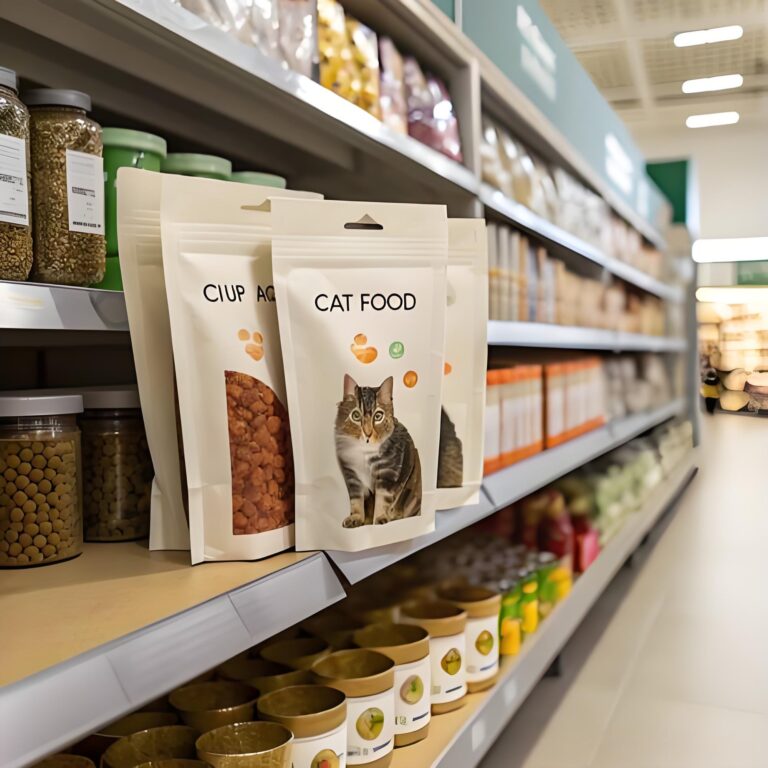
Stand-up pouches feature expansive front and back panels printed on flexible film, typically with vivid color reproduction. The curved, organic silhouette aligns well with natural, wholesome, or modern brand identities. Integrated press-to-close zippers deliver a reseal function that consumers have come to expect in treat categories.
The trade-off: pouches depend on retail display hardware (pegs, racks, or bins) to stay visible. Left unsupported, a pouch collapses outward and obscures the branding. In a dense shelf environment, a rigid carton that holds its own posture tends to capture attention more reliably than a pouch vying for the same sightline.
Verdict: Cartons suit structured retail environments and premium positioning; pouches complement natural, specialty, or contemporary brand stories.
Protection: Physical Integrity and Shelf Life
Mechanical Durability
Cartons: The rigid enclosure shields delicate contents from crushing forces, impact damage, and stacking pressure. This is especially relevant for freeze-dried items—porous, brittle pieces that crack under minimal load. Heavier products like large dental bones also benefit from a container that won’t deform under its own weight.
Pouches: Flexible film walls offer negligible structural defense. Sharp-edged treats can pierce the material; dense product loads pull the package out of shape; pallet stacking transmits pressure directly to the contents. For robust items (standard kibble, soft chews) this is manageable; for fragile or angular goods, it’s a genuine vulnerability.
Barrier Performance
Cartons: Standard paperboard provides moderate resistance to moisture and oxygen—adequate for many shelf-stable treats but insufficient for highly sensitive formulations. Barrier liners or internal bag-in-box configurations can upgrade protection, though they increase material complexity and unit cost.
Pouches: The multi-layer laminated construction of flexible pouches delivers high-barrier performance that paperboard alone cannot rival. Foil-containing structures achieve oxygen transmission rates approaching zero, a critical requirement for wet treats, semi-moist recipes, and raw freeze-dried products where freshness directly affects safety and palatability.
Verdict: Pouches excel at moisture and oxygen defense; cartons provide essential crush protection for fragile goods.
What the End Consumer Experiences
Opening and Reclosing
Cartons: A tuck-end carton opens smoothly but offers no reliable reseal—consumers typically fold the flap loosely or clip it shut. Glue-sealed cartons tear open and cannot reclose at all. For single-use or quickly consumed products, this is negligible. For items used across multiple occasions, it becomes a daily inconvenience.
Pouches: The resealable zipper on a stand-up pouch opens and closes repeatedly with minimal effort. For treat categories where partial consumption is the norm, this convenience feature has shifted from a differentiator to a baseline expectation.
Storage and Handling at Home
Cartons: Rectangular cartons stack neatly in cabinets and occupy predictable shelf volume. Even half-empty, they hold their form—easy to grab, carry, and tuck back into place.
Pouches: As product is consumed, the pouch body compresses and shrinks its footprint—a minor space-saving benefit. However, a nearly empty pouch turns floppy and unwieldy, which frustrates users with tight pantry organization.
Verdict: Pouches win on reseal convenience; cartons outperform in pantry organization and handling.
Breaking Down Production Economics
Per-Unit Material Costs
Material expense depends on dimensions, print complexity, and order quantities. The table below offers directional benchmarks:
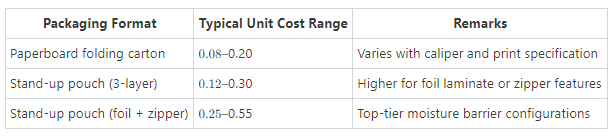
At scale, carton blanks generally undercut pouch materials on a per-unit basis. For smaller production runs, however, the upfront charges associated with carton printing (plates, cutting dies) can make pouches the more cost-effective entry point.
Capital Equipment Investment
Automated carton folding machines configured for pet food applications: 80,000to200,000 for fully automatic lines. Semi-automatic configurations start around 35,000to80,000.
Premade pouch filling and sealing lines: 60,000to180,000 for standard stand-up pouch systems. Lines with integrated zipper application and gas flushing can exceed $200,000.
At comparable automation levels, the capital outlay for cartoning versus pouch equipment falls within overlapping ranges—making the decision more about format fit than about one pathway being materially cheaper.
Secondary Packaging Requirements
A meaningful cost differentiator: rigid cartons frequently ship as-is in master cases, eliminating the need for additional protective packaging. Pouches almost always demand corrugated trays, divider inserts, or other stabilizing elements to maintain shape throughout the distribution cycle—typically adding 0.05to0.20 per unit.
Logistics and Supply Chain Efficiency
Pallet Configuration
Cartons build uniform, stable pallet loads that maximize warehouse cube utilization and racking density. Pouches, even when case-packed, create less predictable stacking surfaces and are more prone to load shift during transport, which translates to higher damage rates and handling overhead.
Freight Optimization
For low-density products (light treats, supplements), flexible pouches can compact to higher case-fill densities than rigid cartons, potentially trimming outbound freight volume. For heavier product categories, the two formats converge on shipping efficiency.
Channel-Specific Distribution Demands
Large-format pet retailers typically favor cartons for shelf-stable SKUs owing to their planogram-compatible dimensions and shelf-ready presentation. Pouches see stronger adoption in natural grocery, independent specialty, and e-commerce channels, where the flexible format aligns with brand storytelling and unboxing experiences.
The Sustainability Dimension
Environmental considerations increasingly influence pet food purchasing decisions. Consumers who prioritize sustainable packaging for their own groceries extend that same scrutiny to what they buy for their animals.
Paperboard cartons benefit from established recycling infrastructure—recovery rates for paper-based packaging exceed 70% across most industrialized markets. When sourced from certified sustainable forestry (FSC), cartons carry a strong environmental narrative that resonates with eco-conscious pet owners.
Multi-layer flexible pouches, while technically recyclable through specialized programs, face practical barriers: most curbside collection services reject them, and consumer participation in store-drop-off recycling for flexible packaging remains low. This gap between theoretical and actual recyclability shapes brand perception in sustainability-focused market segments.
Industry data reinforces the trend: according to Packaging Gateway’s 2024 pet food packaging report, nearly two-thirds of brand decision-makers ranked recyclability among their top three packaging criteria—a dynamic that strongly favors carton-based solutions in environmentally sensitive consumer demographics.
Verdict: Cartons lead on recyclability credentials and sustainability perception.
How to Decide: A Practical Framework
A Cartoning Line May Be Your Best Fit When:
1.Your product is crush-sensitive or brittle (freeze-dried items, delicate supplements)
2.Your primary distribution runs through mainstream retail with planogram discipline
3.Sustainability positioning is integral to your brand identity
4.You want to maximize printable surface area for brand and regulatory information
5.Your product does not demand extreme moisture or oxygen barriers
6.You ship through conventional logistics channels with pallet-stacking requirements
A Pouch Filling Line May Be Your Better Match When:
1.Your product requires robust moisture or oxygen protection (wet treats, semi-moist formulations)
2.Consumer expectation for resealability is strong in your specific category
3.Your brand voice is built around natural, organic, or modern aesthetic cues
4.Your go-to-market strategy centers on DTC e-commerce or natural/specialty retail
5.Your product texture is soft or pliable and gains no benefit from rigid containment
A Hybrid Strategy
Some pet food companies operate both line types across their portfolio: carton folding machines for dry treats and supplements, pouch systems for moist or semi-wet products. This approach aligns packaging format to each SKU’s functional needs rather than forcing a single format onto fundamentally different product profiles.

Making the Evaluation Concrete
The cartoning-versus-pouch decision touches brand strategy, retail positioning, consumer expectations, and your manufacturing roadmap—it’s never just an equipment question. At UBL, we work alongside pet food and treat producers to move this evaluation from abstract comparison to a grounded, numbers-driven recommendation tailored to your specific product lineup and volume projections.
Whether you’re launching a new pet brand, reassessing an existing packaging line, or expanding into additional retail channels, our team brings practical experience across both cartoning and related packaging technologies to help you weigh the options with real data relevant to your operation.
Explore our pet food packaging solutions or browse our full range of carton folding machines to begin the conversation.
Published by UBL Packaging — industrial carton folding machine manufacturer specializing in automated cartoning solutions for food, pet care, pharmaceutical, and consumer goods sectors.
Post time: May-25-2026