


The pet industry has exploded into a landscape of niche brands, artisanal producers, and specialty manufacturers—and not all of them operate like massive factories churning out tens of thousands of units daily. From boutique dog treat bakeries to custom supplement formulators, a growing segment of pet product companies runs lean production lines with short runs, wide SKU variety, and modest output targets.
For these businesses, selecting cartoning equipment requires an entirely different lens than what guides high-volume operations. This article breaks down the essential factors to evaluate when sourcing packaging automation for small-batch pet manufacturing.
Defining Small-Batch Production in Pet Packaging
When equipment suppliers refer to “small batch” in the context of pet product packaging, they generally mean production quantities ranging from roughly 500 to 5,000 finished cartons per individual SKU, accompanied by regular switching between distinct products, pack sizes, or seasonal editions.
Which Pet Businesses Fit This Profile?
Small-batch packaging scenarios are especially common among:
Artisanal treat makers crafting multiple flavor varieties in limited production lots
Private-label co-packers fulfilling different retail customer SKUs on shared machinery
Emerging brands validating market demand through pilot runs before scaling up
Seasonal or holiday-themed product lines manufactured only once or twice annually
Contract packaging facilities handling numerous smaller pet brand clients on one line
Functional nutrition brands producing low-volume therapeutic or prescription-specific formulas
The Core Challenge Facing Small-Scale Producers
Here’s the dilemma that most small-batch pet manufacturers face: relying on manual boxing offers maximum flexibility—you can pivot between products almost instantly—but labor costs per unit become painfully high on premium goods with already-thin margins.
Conversely, investing in conventional industrial-grade automation drives down per-unit cost but introduces lengthy setup procedures between jobs. When reconfiguring a machine eats up two hours, running a batch of just a few hundred cartons simply doesn’t make financial sense.
The ideal solution lies in mid-range equipment purpose-built for rapid changeovers at practical speeds—machines that let you switch between SKUs quickly without sacrificing reasonable throughput.
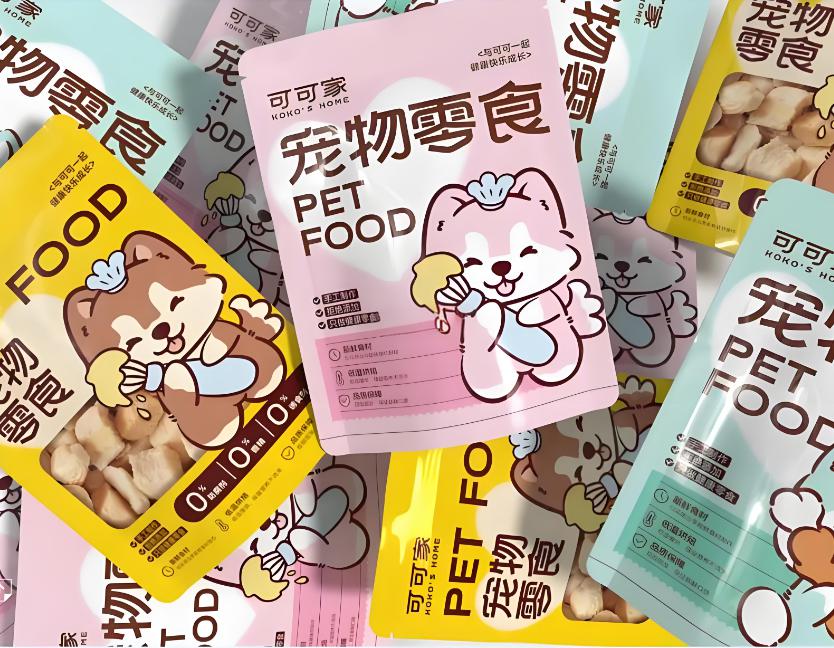
Vibrant custom-printed cartons for pet snacks and accessories—small-batch brands rely on eye-catching packaging to stand out on crowded retail shelves.
Critical Specs to Prioritize When Evaluating Equipment
Changeover Speed Should Be Your Top Priority
In small-scale operations, how fast you can swap from one job to the next matters far more than peak operating velocity. Consider this scenario: if your facility handles ten separate SKUs each week at around 800 units per run, and every format change consumes an hour, you are surrendering ten hours weekly—roughly a quarter of your productive capacity—purely to changeover downtime.
Seek out equipment featuring:
Tool-less dimensional adjustment: Hand cranks, ergonomic levers, and quick-release mechanisms replace bolts, wrenches, and tedious manual tuning
Servo-controlled positioning: Digital axis control enables operators to recall saved dimension profiles rather than manually recalibrating every setting
Programmable recipe storage: Save complete configuration sets for each product so switching SKUs means loading a saved program—not measuring and readjusting each guide rail individually
Realistic changeover target: Under 15 minutes for routine size transitions between standard carton formats
Production Speed: Align With Actual Demand
A compact operation rarely needs equipment capable of 4,000 cartons hourly. Overbuying speed means capital tied up in unused capacity. For the majority of small-batch pet manufacturers, a 600–1,500 carton-per-hour range hits the sweet spot:

Carton Dimension Compatibility
The universe of pet product packaging spans a huge spectrum—from tiny single-serve sachets holding a few freeze-dried treats all the way up to bulky gift boxes for multi-item toy bundles. A well-designed small-batch cartoner ought to accommodate:
Smallest feasible carton: approximately 60 × 30 × 15 mm
Largest practical carton: approximately 300 × 200 × 100 mm
Full-range adjustment without tool swaps: Purely mechanical or digital adjustment across the entire envelope
Important caveat: Always verify that any machine under consideration genuinely covers your specific carton dimensions. Some entry-level models advertise broad ranges but require costly tooling modifications or add-on kits when you push toward the upper or lower extremes.
Loading Mode Versatility
Small-batch pet catalogs frequently include products that simply don’t cooperate with automated feeding systems—odd-shaped plush toys, brittle freeze-dried morsels that crumble under mechanical pressure, or gift sets combining loose components inside one box.
For such cases, semi-automatic mode (the machine forms and seals cartons while operators manually insert products) frequently delivers the optimal compromise.
Watch our pet box folding machine demonstration video to see semi-auto and full-auto loading options in action.
Ideally, select a cartoner offering dual-mode capability: fully automatic for straightforward products and manual-load mode for tricky items—all on the same piece of equipment.
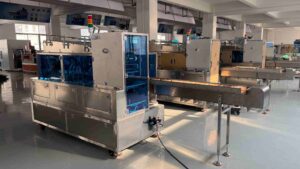
UBL’s multi-format compatible cartoning system—GMP-compliant stainless steel construction designed for food-grade and supplement packaging environments.
Semi-Automatic vs. Fully Automatic: The Key Decision
Choosing between semi-auto and full-auto represents the pivotal choice for small-scale pet packaging lines:
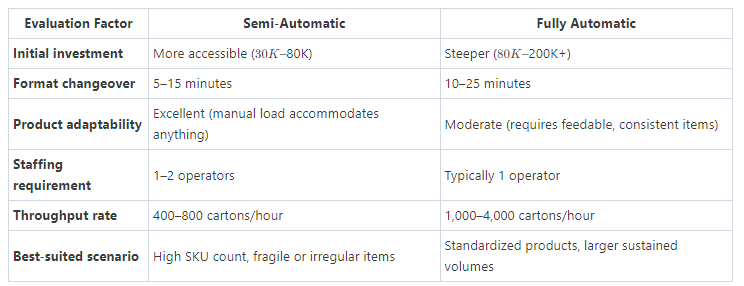
Bottom line: For most small-batch pet businesses producing fewer than 3,000 cartons daily across a diverse SKU portfolio, a semi-automatic cartoner delivers stronger ROI. The combination of lower purchase price, broader product tolerance, and quicker job changes tends to outweigh raw speed advantages at these volume levels.
The Standalone Carton Erector Alternative
For pet manufacturers whose biggest bottleneck is specifically the box-forming step—not product insertion or final sealing—a dedicated carton erector can serve as a smart, phased entry into automation without committing to a full cartoning line upfront.
How It Works in Real Operations
Consider a pet accessory company managing frequent short-run batches across many SKUs. Their workers commonly spend somewhere between 30% and 40% of total packaging labor purely on manually folding and erecting carton blanks. A lock-bottom erector eliminates that time sink entirely—the machine continuously forms and delivers open boxes while staff concentrate on filling and sealing them.
One UBL client—a mid-size pet toy producer—deployed exactly this approach. A single carton erector served their entire packaging area. Workers formerly assigned to hand-folding were reassigned to product loading duties, boosting overall packaging output by over 30% with zero new hires. The equipment achieved payback in under 14 months.
This strategy is particularly effective for small-batch setups because it offers:
Significantly lower capital outlay versus a complete auto-cartoning system
Negligible downtime when swapping between carton sizes
Continued operator flexibility for hand-loading varied or delicate contents
Zero interference with existing downstream processes
Budget Planning for Small-Batch Packaging Automation
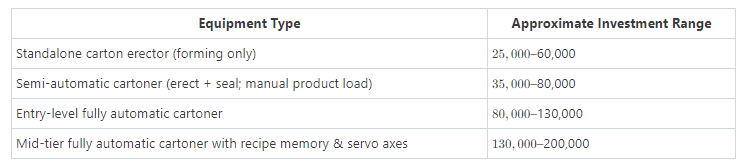
Equipment Price Benchmarks
Realistic cost expectations by equipment category:
Don’t Forget These Additional Costs
Plan beyond the sticker price:
Installation and commissioning: typically 5,000–15,000 depending on site complexity
Operator training: often bundled with purchase, but allocate internal calendar time for team onboarding
Spare parts reserve: budget roughly 2–5% of machine value annually for wear-part replacement
Carton design verification: certain machines require minor adjustments to your existing carton blank specifications for reliable pick-up and feeding performance
Financing Pathways
Equipment leasing has become a popular option among small-batch producers facing capital constraints. Lease payments in the neighborhood of 1,500–3,500 monthly for a semi-automatic setup are frequently neutralized by labor-cost reductions within the first several months of operation—meaning leasing can turn cash-flow positive surprisingly early in the term.
Essential Questions to Pose to Suppliers
Before making a purchasing commitment, put these questions to every vendor you evaluate:
What is the demonstrated changeover time between my specific carton formats? Insist on witnessing a live demo rather than accepting brochure claims.
Does the machine handle both tuck-end (tuck-top) and glue-seal closure styles, or is it restricted to one type?
What is the jam-clearance procedure? How long does it take a typical operator to resolve a stuck carton?
Is the HMI (operator interface) intuitive enough for non-technical staff to use confidently after minimal training?
What is the lead time for spare-part delivery, and are common consumables stocked regionally?
Can you run my actual carton samples during evaluation before I sign anything?
Designing Your Small-Batch Pet Packaging Line
The right answer for small-batch pet packaging is seldom a single machine off the shelf—it is a thoughtfully configured system tailored to your unique product mix, volumes, and growth trajectory.
At UBL Packaging, we partner with emerging and established pet brands alike to engineer solutions that automate the highest-value stages of the packing process while preserving the operational agility that small-batch production demands.
Whether your starting point is a standalone carton erector, a flexible semi-automatic cartoner, or a scaled fully automatic line, our engineering team can specify equipment matched precisely to today’s output levels—with clear upgrade pathways as your business expands.
Explore our complete catalog of pet product packaging solutions or contact us directly to discuss your requirements with no obligation.
Ready to assess your small-batch pet packaging needs? Reach out to UBL Packaging today for a complimentary consultation.
Post time: May-25-2026