


For most baked goods producers, the wake-up call does not arrive during a trade show walkthrough or a supplier presentation. It arrives when the monthly performance review shows output up by twenty percent — while net profit remains pinned to the same number it sat at the quarter before. More purchase orders. More shifts scheduled. More hands on the floor. Identical margin. That cycle, playing out across consecutive reporting periods, is the clearest signal that the secondary packaging stage has become a structural lid on the business — and that hands-on carton packing is the specific chokepoint dragging everything down.
This article breaks down how automated cake packaging equipment resolves the four most pressing operational pain points baked goods producers confront at the cartoning stage: escalating workforce expenditure, inconsistent carton quality, contamination exposure during product handling, and the fundamental impossibility of expanding throughput without expanding headcount at the same rate.
Workforce expenditure in the food processing sector continues to outpace output growth at manual packing stations.
The Hidden Cost Structure Behind Manual Cartoning Stations
Why “Just Add Another Worker” Never Works Out
A packing station staffed by three to five people looks reasonable in a cost spreadsheet. In reality, every one of those positions carries a cluster of expenses that never surfaces as a single line item: time invested in recruiting and interviewing, mandatory food safety certification, onboarding documentation, insurance contributions, and the inevitable drag in output while newcomers learn the correct insertion depth and flap-closing pressure. Across most food processing markets, the true annual expenditure per packing station worker — once statutory contributions, insurance, training investment, and replacement costs from turnover are factored in — runs between 1.4 and 1.8 times the base wage figure. When that multiplier is applied across a station running four workers on dual shifts, the actual yearly cost of a manual cartoning setup becomes impossible to ignore. And in the majority of cases, it surpasses the acquisition cost of the equipment that would replace it.
Brand Reputation Risk From Inexperienced Hands
Manual packing stations suffer from a consistency deficit that worsens every time the rotation brings someone new onto the line. Veterans understand the precise angle for insertion, the correct force for tuck-flap engagement, and how to spot a misaligned carton before it travels downstream. Recent hires do not — and the fallout is anything but abstract. Tuck-end flaps that spring apart on store shelves, corners that look dented straight out of the case, transparent display windows scratched during the loading motion — these are the precise defects that trigger retailer chargebacks and end up photographed in consumer reviews. For a baked goods brand supplying supermarket chains or e-commerce grocery channels, even a small batch of packaging complaints can undo retail partnerships that took years to cultivate.
The Scaling Paradox: Revenue Climbs, Profit Stalls
When order volumes surge, a facility dependent on manual packing has exactly one response: bring in more people. That response is expensive, sluggish, and bound by diminishing returns. Seasonal temps carry higher per-head rates while delivering lower throughput. Permanent additions demand months of recruitment and onboarding — incompatible with a three-week demand spike. The outcome is a company that grows its top line but cannot expand its margin, because every additional unit produced requires an additional unit of labor that consumes the profit embedded in that unit. Left uncorrected, this dynamic compounds over consecutive quarters until the operation becomes structurally unprofitable at higher volumes.
Food processing companies face escalating workforce overhead and hidden labor costs at manual cartoning stations. New hires introduce packaging defects and brand risk, while adding headcount to chase output gains only erodes margins further.
What Automated Cake Packaging Equipment Actually Does
The Complete Secondary Packaging Sequence, Mechanized
A UBL automated cake packaging unit executes the entire secondary packing sequence in one uninterrupted mechanical loop: blank erection from the magazine, flap opening on the infeed side, product insertion via pusher assembly, tuck-end flap sealing, and finished carton discharge onto the exit conveyor. The only point where human involvement is required sits at the product loading position — a single operator placing the product or tray into the intake channel at the correct orientation. Every operation between the blank feeder and the sealed carton exit is performed by the machine itself.
For a baked goods producer previously running four people at the cartoning station — one erecting boxes, two loading product, one sealing flaps — this configuration consolidates the station to a single operator. The workforce reduction is immediate and permanent from the first production run. Beyond that, the equipment’s throughput is unaffected by shift transitions, rest breaks, cumulative fatigue, or the experience gap between a seasoned operator and someone in their second week on the line.
Contamination Control at the Product Contact Stage
At a manual packing station for baked goods, every individual who handles cartons, repositions product, or closes flaps represents a potential contamination vector. Facilities manage this exposure through disposable gloves, hair restraints, and sanitation SOPs — each of which adds compliance overhead, and none of which fully eliminates the risk. An automated cake packaging system removes human contact from the box-erection, product-loading, and flap-sealing stages entirely. The only human touchpoint in the automated sequence is at the intake, where individually wrapped product enters the loading channel. For producers operating under HACCP certification or third-party food safety audit frameworks, cutting manual contact points in the secondary packing stage delivers both an operational upgrade and a measurable compliance advantage.
Automated equipment ensures food safety and contamination control throughout the secondary packaging process.
Uniform Tuck-Flap Closure on Every Single Carton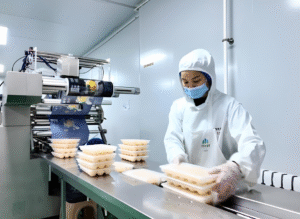
Tuck-end carton sealing demands consistent mechanical pressure applied at the correct angle to both end flaps simultaneously. Manual operators achieve acceptable results through repeated practice and ingrained habit — which means their precision degrades as a shift progresses and fatigue sets in, and fluctuates between individuals based on grip strength and personal technique. An automated cartoning system applies identical closing force and geometry to every carton in every cycle, regardless of how long the shift has been running. The output is a shelf-ready package that looks indistinguishable from the first box of the day to the last — clean corners, fully engaged flaps, pristine display windows.
Field Example: A Frozen Bakery Producer Scaling Without Expanding Headcount
A manufacturer specializing in frozen retail baked goods — individually wrapped Swiss roll slices, eight units per retail tuck-end carton — operated a manual packing station with three to four workers. As retail buyer volumes climbed and a second production shift was added, the station required six to eight packing workers across both shifts to sustain throughput. Following the deployment of two UBL automated cake packaging machines, the station’s direct labor dropped from six-to-eight workers across dual shifts down to two — one intake operator per machine, per shift. The equipment runs at 50 to 700 cartons per minute, surpassing the manual line’s sustained average of 18 to 22 cartons per minute while eliminating the throughput dips that occurred whenever temporary staff struggled with the tuck-end closure technique.
The arranged Swiss rolls are being pushed into cartons and sealed by the UBL cake packaging machine.
The integration was straightforward: the upstream tray line delivered individually wrapped slices onto a belt feeding each machine’s intake. The operator positioned each tray at the loading point. The machine handled blank erection, product insertion, and flap sealing. Finished retail cartons exited onto a connecting conveyor leading directly to the downstream cold-chain packing stage. The existing carton design — a tuck-end box with a transparent display window — required zero modification. The line was operational within 48 hours of installation, including operator orientation and speed calibration.
Return on Investment: Why Baked Goods Producers Recover Capital Faster
Why Predictable Order Volume Shortens Payback
Baked goods producers supplying retail or foodservice channels typically work under purchase orders or supply contracts with defined volume commitments. This production predictability is what makes ROI projections for cake packaging equipment dependable: there is no ambiguity about whether the machine will accumulate enough cycles to justify the capital outlay. A facility operating five days per week on dual shifts, running a machine at 25 cartons per minute for six productive hours per shift, produces approximately 900,000 cartons per month through a single unit — a throughput no manual station can approach at comparable labor expenditure.
When the annual savings from consolidating a four-person manual station into a one-person automated station are measured against the equipment’s acquisition cost, the payback window for most baked goods operations in current workforce cost environments falls between ten and fourteen months. In markets with higher labor expenditure or where the line runs beyond two shifts, recovery can be even faster. UBL’s engineering team provides a documented ROI analysis tailored to each client’s specific labor cost structure, shift configuration, and target output volume prior to purchase.
What Does Not Change After the Transition
A common concern raised by baked goods producers before committing to automated cake packaging equipment is whether the transition forces changes to product format, carton specifications, or downstream packing flow. In the standard deployment scenario, none of these change. The machine is configured to match existing carton dimensions and current product format. The downstream conveyor interface is a direct mechanical interface that typically takes under a day to complete. The operations team learns the machine’s HMI and intake procedure in a two-hour orientation session — most operators are running the equipment independently within two to three days. The shift from manual to automated is an equipment installation and a crew reduction, not a production line redesign.
Selection Criteria: What to Evaluate Before Purchasing
Carton Style and Closure Format
Tuck-end cartoners process standard tuck-end (double tuck end) box formats — both end flaps inserted and interlocked. This is the prevailing box style for retail baked goods and confectionery packaging. If your current carton uses an alternative closure method — snap-lock bottom, adhesive seal, or hinged lid — a different cartoner configuration is required. UBL’s technical team reviews the carton specification and product format before recommending a specific model. Sending physical samples of both carton and product for a trial run at UBL’s facility before purchase is the established procedure for confirming compatibility.
Food cartoning equipment in operation, automatically packaging products into cartons on a high-speed production line.
Throughput Matching and Upstream Integration
The machine’s operating speed must be synchronized with the upstream feed rate — whether from a tray line, a conveyor belt, or a manual loading operator. Running the equipment faster than the upstream supply allows creates idle cycles without improving output. Running it slower than the upstream supply creates a bottleneck. UBL’s engineering team maps the client’s existing line layout and upstream output rate to configure the cartoner at the appropriate speed before installation. This synchronization is part of the standard pre-sale technical assessment.
Sanitation Standards and Material Requirements
Baked goods producers operating under specific sanitation classifications — particularly those handling fresh or refrigerated products — may require equipment surfaces compatible with periodic cleaning or washdown procedures. UBL’s cake packaging machines are constructed with food-contact-adjacent surfaces in stainless steel where the product format and customer specifications call for it. If your facility operates under a defined food safety standard that specifies equipment material requirements, this should be confirmed with the UBL team during the product review phase.
How to Get Started
UBL offers sample trial runs before purchase. Send your product sample and carton blank to UBL’s facility, and the engineering team will execute a test cycle on the machine and provide video documentation of the results — including carton closure quality, cycle speed, and any format adjustments needed. Standard tuck-end cartoner configurations are available for next-business-day dispatch after contract signing. Custom configurations for non-standard carton dimensions or specific sanitation requirements typically ship within three months after design confirmation.
Post time: Jul-24-2026