


An ice cream cartoning machine earns its place at the cold end of a frozen dessert plant for reasons that have little to do with speed figures on a brochure. The cups arrive from the filling and hardening tunnel cold, slightly wet with condensation, light for their footprint, and easy to tip. They need to be counted into groups, usually four to a retail carton, loaded without crushing the rim seal, and closed in a box that will sit straight on a retail shelf. None of those steps is hard for a person. All of them are hard for a person to repeat identically for eight hours in a cold room.
The deployment pattern this article describes comes from a project our engineering team delivered for a frozen dessert manufacturer supplying a major North American retail chain. The retailer and the plant stay unnamed, because what transfers to your line is the engineering: how the cups behave, how grouping is automated, and how the payback is calculated. Those apply to ice cream, frozen yogurt, gelato cups, and most novelty products that reach the cartoning station in sealed primary packaging.
Why frozen cups are awkward secondary packaging
Four properties make a frozen dessert cup harder to carton than its room-temperature equivalents.
Condensation. Cups leaving the hardening tunnel carry surface moisture. On a conveyor this changes the friction between cup and belt unevenly — a wet cup slides where a dry one grips. Any grouping mechanism that relies on consistent friction needs to account for the wet case, not the dry one shown in a demonstration.
Low mass, high centre of gravity. A typical retail cup is mostly air by volume until the lid is on. It tips when a pusher applies force above its centre line, and it tips silently — the fault shows up as a jam three stations later.
Group counts that change with the SKU. The same plant may run four-count retail cartons, six-count family boxes, and two-count multipacks, so the grouping logic has to change without a mechanical rebuild.
A rim seal that must not be touched. The lid seal is the food-safe boundary. Any handling step that presses on the rim is a risk to the seal and, downstream, a quality complaint from the retailer’s receiving inspection.
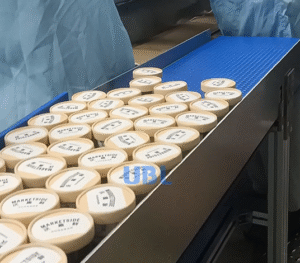
Where the manual line stops scaling
A manual cup-to-carton line runs three stations: counting, loading, and closing. At low volume it works. As the retail order book grows, three structural problems appear — and they are visible in public labour data.
The first is staffing. United States food manufacturing employed about 1.77 million people in August 2026, down roughly 1.1 percent year on year, per the Bureau of Labor Statistics. The people still on the floor are working more: production employees in food manufacturing averaged 4.2 hours of weekly overtime in July 2026 against 3.1 hours across all manufacturing. Filling a counting station on a frozen line at short notice is harder than filling one on a dry goods line, and the overtime figures say plants are already stretching crews.
The second is consistency. A counting station staffed by people produces occasional three-cup and five-cup cartons, each of which has to be caught at inspection, opened, corrected, and resealed. Fatigue drives the error rate up in the second half of the shift, when the inspection bench is thinnest.
The third is injury exposure. Food manufacturing recorded 3.3 work-related injury and illness cases per 100 full-time workers in 2024, against 2.7 for manufacturing overall, per the BLS survey data. Repetitive reaching in a cold room is a known contributor. Moving the repetitive work out of the cold room is a safety decision as much as a productivity one.
None of this means manual packing is wrong. It means the manual configuration has a ceiling that arrives before the retailer’s order volume does, and the plant hits it in a season, not over years. An ice cream cartoning machine does not remove that ceiling by working faster at the same three stations — it removes the stations.
What the automated sequence looks like
The line architecture we deployed for the North American project has four stages, and the same architecture fits most sealed-cup products.
Stage one: arrival and orientation. Cups arrive in a single lane, and a vision system reads each cup’s position and orientation — cups from a hardening tunnel are never indexed the way a dry-goods line is. The vision layer replaces an assumed orderly arrival with a measured one.
Stage two: grouping. A pick-and-place unit lifts the cups into a formation — four in a two-by-two block for the retail carton here — and places it on the cartoner infeed. Because the pick coordinates live in the recipe rather than in a cam, changing a four-count to a six-count formation is a parameter change, not hardware.
Stage three: cartoning. The cartoner draws a flat blank from the magazine, erects it, and holds it open at the loading position. A servo-driven pusher advances the cup formation into the box in one motion, its acceleration profile tuned to the cup’s centre of gravity so nothing tips on entry. It then closes and tucks the flaps. Lines that prefer to pre-erect boxes upstream of the loading station can feed the same sequence from a buckle-bottom box erecting machine instead of drawing flat blanks at the cartoner.
Stage four: discharge. Sealed cartons exit to the outfeed, where the line continues into checkweighing, labeling, or case packing as the layout requires.
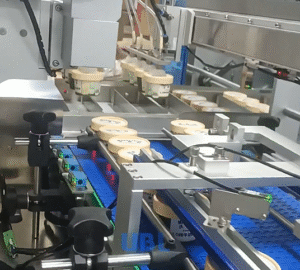
On our servo tuck-end cartoning machine (model HL-ZC-G1), the published running range is 3,000–4,800 cartons per hour — 50 to 80 per minute — on a 5.8 kW supply with 200 NL/min of air at 0.6–0.8 MPa. Two caveats belong next to those figures. The achievable rate depends on the cup formation and the carton format — a six-count box does not run at the pace of a four-count. And the rated box envelope is 120–200 mm long, 60–140 mm wide, and 30–70 mm high: frozen dessert cartons often sit near the upper end of the width and height limits, which is why a carton blank sample belongs in the specification conversation before any quotation.
The hygiene boundary that matters in dairy
Frozen dairy production carries food-safety obligations a dry goods line does not, and secondary packaging is where the audit trail is easiest to clean up. Once the cup leaves the filling line with its lid sealed, every subsequent operation is packaging, not food contact. A cartoning line that groups and loads without a human hand touching the cups removes the manual contact points from the entire post-seal sequence — which is a shorter food-safety conversation with any auditor than a line that manages them with gloves and procedure.
The machine construction matters as much as the sequence. Food-area equipment is built for washdown adjacency, low-temperature operation, and condensation that a room-temperature plant never sees. Ask any supplier three questions: which surfaces are food-area rated, how the machine behaves at the temperature your hardening tunnel delivers, and what the cabinet rating is in a wet cold room. The answers separate equipment designed for food plants from equipment painted white.
Grouping, changeover, and the recipe logic
Grouping is where most cartoning projects succeed or quietly disappoint, because grouping is the step the product defines — a principle that repeats across packaging equipment, as we wrote about in a custom clothes folding machine project where standard equipment did not fit. The same pick-and-place unit that forms a two-by-two retail formation can form a two-by-three family pack or a one-by-two multipack, with coordinates stored per SKU in the control recipe. Changeover between SKUs is a recipe recall plus physical adjustments — magazine, guides, pusher stroke — and the honest measure is from the last good carton of one run to the first good carton of the next.
A missing-cup condition is worth asking about explicitly: if the vision layer counts three cups where four should be, the cycle should be skipped and logged, not loaded. The failure mode to avoid is the carton that receives a short count and closes anyway — receiving inspection will find it, at a cost out of proportion to the defect.
The payback arithmetic on published wage data
Plant-level case numbers do not transfer between facilities, so this section uses public data that does. The Bureau of Labor Statistics reports median pay of $21.32 an hour for packaging and filling machine operators in food manufacturing (OEWS, 2025), an annual median of $44,350. Applying a 1.3 loading factor — a planning allowance for employer taxes, insurance, and benefits that each plant should replace with its own rate — gives a fully loaded cost of roughly $57,700 per packaging position per year.
That figure converts station counts into money. The table below is arithmetic, not a quote: multiply your own station count by your own loaded rate.
| Grouping and loading stations removed | Annual value at 60% capture | Annual value at 70% capture |
| 4 | about $138,000 | about $161,000 |
| 5 | about $173,000 | about $202,000 |
| 6 | about $208,000 | about $242,000 |
The capture rate accounts for what actually happens when a line automates: people move to monitoring, inspection, and changeover roles rather than disappearing from the payroll. A planning range of 60 to 70 percent reflects that reality for most frozen-food deployments. Payback is then the equipment and integration investment divided by the captured annual value — every supplier who quotes you a payback period without showing you this division is doing your business case a disfavour.
Two indirect savings sit outside the table and pull the same direction: rework from miscounted cartons disappears with the manual stations, and repetitive cold-room reaching leaves the job descriptions. Neither shows up in the payroll line; both show up in the cost of quality.
The trial that settles it
A cup cartoning project should never go to purchase order on specification sheets alone — an ice cream cartoning machine is bought on evidence from your own frozen cups. The trial that matters uses your materials, in conditions close to yours:
- Your cup, filled and lidded, chilled — not a warm empty cup, because warm cups behave differently on a conveyor
- Your carton blank, exactly as printed and die-cut for the retail format
- Your target formation, whether that is a four-count or a family pack
- A run long enough to see the behaviour after the first fifty cartons, not just the first five
Watch the grouping, the pusher entry for tip-over, and the flap closing for a consistent seal line, and count the rejects. The trial report should give a sustained rate, a reject rate, and a changeover between two formations. Those three numbers, from your own materials, are the only throughput figures worth writing into the purchase justification.
Common questions
Can one machine handle different cup sizes and carton formats?
Cup-dependent steps — the gripper, the guides, the pusher stroke — are adjusted per recipe, and the cartoner’s box envelope (120–200 × 60–140 × 30–70 mm on the HL-ZC-G1) defines the format range. Formats that sit inside the envelope are recipe changes; formats outside it need a different configuration — front-opening display cartons and blanks sealed by bottom latch or glue spray, for instance, run on our forward-opening servo cartoning machine. Confirm with carton blanks before deciding.
How does the line prevent a short count from being boxed?
The vision layer verifies the formation before release. A short count skips the cycle and logs the event, so the carton magazine is never consumed on an incomplete group.
What happens to the workers at the removed stations?
The common pattern is redeployment to monitoring, inspection, and changeover roles — the automated line still needs people, fewer of them doing repetitive cold-room reaching. The 60–70 percent capture assumption in the payback table reflects this.
Is a robotic grouping stage necessary, or is a mechanical grouper enough?
Mechanical groupers work for rigid, uniform products arriving well-indexed. Frozen cups arrive from a hardening tunnel neither rigid nor evenly spaced, which is why the vision-plus-pick configuration is the usual answer. If your cups arrive clean and indexed from an upstream unit, the simpler option may be enough — a trial answers it.
How long does a custom cup-to-carton line take from order to running?
Standard cartoner configurations ship quickly; a line with vision-guided grouping and upstream integration is an engineering project — plan around design confirmation, manufacture, and commissioning, and ask for the schedule in writing. Support after commissioning matters as much as the schedule before it; what to expect from a supplier once the line is running is covered in our article on after-sales service for automatic labeling machines.
Send the cups, not the question
The specification that matters is not the machine’s — it is your product’s. Send filled, lidded, chilled cup samples and your printed carton blanks, tell us the formation and the target rate, and we will run the group-and-carton sequence on video, including a changeover and a reject-rate count. You review the footage before any commercial step.
To discuss a frozen cup cartoning line:
Email: sales@huanlianauto.com
Post time: Nov-13-2026