


Price is where most enquiries start, and the useful answer is more specific than “it depends”. Prices for this equipment class sit in identifiable bands, and once you know which band your operation belongs in, the second question — how long until the machine has paid for itself — becomes a calculation rather than a guess.
The framing worth keeping in mind: a folding machine that removes five manual packing positions is not a five-person expense. It is a capital outlay that begins returning labour cost from the first full production day. This article covers the price bands, what moves a quotation up or down within them, and a payback model built on published wage data rather than on a round figure someone picked.

Where the price bands sit
Semi-automatic single-station machines
A semi-automatic single-station folder — the operator loads the garment, the machine performs the fold sequence — typically lists in the range of $2,000 to $5,000 excluding freight. Configuration accounts for the spread inside that band: a fold-only unit sits toward the lower figure, while a unit with integrated bagging, heat sealing, and optional labeling sits toward the upper one.
Semi-automatic is where most operations start. Two situations point here: daily volume has not yet reached the level where full-automatic arithmetic works, or the available floor space or capital budget does not support the larger line at this stage.
Full-automatic folding and packing lines
A full-automatic garment folding and packaging line typically lists in the range of $20,000 to $30,000 excluding freight, covering the core fold-bag-seal line in standard configuration. Four variables move a specific quotation within that band:
- ●Add-on modules. Labeling stations, automatic stacking units, vacuum compression, courier-bag overbagging, and sorting lines are each quoted on top of the base machine.
- ●Garment coverage. A configuration built around standard tees and lightweight knits is a different machine from a thick-and-thin extended model that handles heavier outerwear.
- ●Engineering scope. Non-standard fold sequences, unusual bag dimensions, or integration with an existing production line.
- ●Freight. Cost varies considerably by destination, port, and shipping mode, and is quoted separately.
A note on these figures: the ranges above describe the equipment class and typical configuration tiers, not a UBL quotation. Actual pricing depends on the module list, garment range, engineering scope, destination, and payment terms. Treat them as a budgeting band, then work from a line-item quotation.
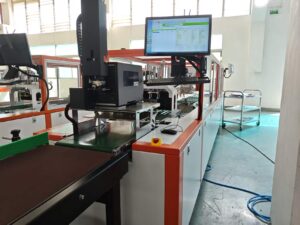
What moves a quotation up or down
| Factor | Where quotations sit lower | Where quotations sit higher |
|---|---|---|
| Automation level | Semi-automatic single station | Full-automatic with several integrated modules |
| Functions in scope | Fold only | Fold + bag + seal + label + stack + vacuum |
| Garment coverage | Lightweight tees and knits | Thick-and-thin extended model for heavier garments |
| Engineering scope | Catalogue configuration | Custom fold sequence, non-standard dimensions, line integration |
| Delivery timeline | Standard machine: ships the day after contract signing | Custom configuration: about 3 months, including layout planning |
The first three rows decide what the machine does. The fourth decides engineering hours. The fifth decides how long your capital is tied up. In negotiation terms, the last two often matter more to the overall cost of ownership than a few percentage points on the headline figure.
Working out the payback
Payback is arithmetic: divide the machine cost by the monthly labour saving it produces. The variables worth being careful about are the wage baseline and how much of the theoretical headcount saving is actually captured.
Wage baseline
For a US operation, the US Bureau of Labor Statistics publishes the figures this calculation needs. For apparel manufacturing (NAICS 315), as of September 2026, average hourly earnings were $23.53 and average weekly hours 36.1 — roughly $44,200 a year, or about $3,680 a month for an all-employee average.
Apply a loading factor for employer-side costs. Using 1.3× as an illustrative multiplier for payroll taxes, workers’ compensation, and benefits, the employer cost per production position comes to roughly $4,785 a month. That figure is an assumption you should replace with your own rate — the multiplication factor in particular varies by state and by workforce composition.
Headcount capture
A full-automatic line running around 600 pieces an hour covers the output of roughly five manual packing positions. But replacing five positions does not mean five people leave the payroll on day one. Some are redeployed, some hours are covered by overtime elsewhere, and attrition takes time. A model that assumes full capture will flatter the result.
| Scenario | Monthly saving, 5 positions | Payback on $20,000 | Payback on $30,000 |
|---|---|---|---|
| US apparel wage, full capture | about $23,900 | under 1 month | about 1.3 months |
| US apparel wage, 70% capture | about $16,700 | about 1.2 months | about 1.8 months |
| US apparel wage, 60% capture | about $14,400 | about 1.4 months | about 2.1 months |
| Lower-wage market, full capture | about $6,500 | about 3.1 months | about 4.6 months |
| Lower-wage market, 70% capture | about $4,550 | about 4.4 months | about 6.6 months |
| Lower-wage market, 60% capture | about $3,900 | about 5.1 months | about 7.7 months |
Two further adjustments push these numbers out, and both belong in a conservative report:
- Time to full output. Installation, commissioning, operator training, and the ramp while fold programs are being tuned all sit before the machine runs at its published rate.
- Freight and site work. The figures above cover the machine only. Freight, insurance, and any electrical or air-supply work at your site are additional.
How this lines up with the warranty
UBL machines carry a one-year warranty covering manufacturing defects in parts and workmanship. Aligning the warranty period with the typical payback window means something practical: for a good share of buyers, the machine has returned its cost before coverage ends, and labour savings beyond that point fall through as margin.
Ongoing costs after the warranty are mainly consumable wear parts — conveyor belts, suction cups, sealing blades — which are low-cost items available direct from the factory. Under normal operating conditions, mechanical components generally have service lives extending well beyond the warranty period.
Semi-automatic versus full-automatic, from the buyer’s side
| Factor | Semi-automatic ($2,000–5,000) | Full-automatic ($20,000–30,000) |
|---|---|---|
| Positions removed | None — one operator remains at each station | Roughly 5 per machine |
| Throughput change | About 30% to 50% above manual at the same headcount | About 2× to 4× manual output with fewer people |
| Main benefit | Consistency per operator, faster output per shift | Direct labour cost removal plus higher throughput |
| What drives payback | Reduced overtime, more output per shift | Direct labour cost saving |
| Suits | Under about 3,000 pieces a day; space or budget constrained | 3,000-plus pieces a day; labour cost is a significant line |
Items to confirm alongside the price
Questions buyers ask about folding machine pricing
Does the quoted price include installation and training?
The UBL machine price includes installation, calibration, and operator training. Freight is calculated separately based on your location and shipping method, and confirmed with the quotation.
Can I get a line-item quotation?
Send garment type, daily volume, the output format you need — fold only, fold plus bagging, fold plus bagging plus labeling — and your delivery address. You will receive a formal quotation itemising the base machine, any add-on modules, and a freight estimate.
Are payment terms or instalments available?
Terms vary by order size and customer situation. Contact the team directly to discuss what is workable for your order.
What does the one-year warranty cover?
Manufacturing defects in parts and workmanship for one year from delivery. Consumable wear parts — belts, blades, suction cups — are expected-replacement items and are not covered, but are available at direct-from-factory prices. Warranty claims are handled through the same support channel as operational issues, under the 6-hour remote response commitment.
Why does our quotation differ from the price bands quoted here?
The bands describe configuration tiers for this equipment class. A specific quotation moves with the module list, garment coverage, engineering scope, freight destination, and payment terms. Use the bands for budget planning and then work from a line-item quotation.
How should we present the payback figure internally?
Present the conservative case. Include commissioning and ramp-up, count only the share of the labour saving you expect to capture, and leave out secondary benefits such as higher throughput or reduced rework from the base calculation. That version holds up under questions.
Where to read next
- Semi-Automatic Clothes Folding Machine — the mid-tier configuration, published capacity of around 400 pieces per hour.
- Custom Clothes Folding Machine: 5 Signs Your Line Has Outgrown Standard Equipment — when a catalogue configuration stops fitting.
- Heavy Garment Folding Automation: A Production Engineer’s Guide — why heavyweight garments are a different engineering problem.
Post time: Oct-19-2026