


A garment folding machine is not a consumable purchase. It sits on your floor for years, running shift after shift, and the supplier you picked becomes an operating relationship whether or not you planned for one.
The moment that relationship gets tested is never pleasant. It is 10:40 on a Wednesday, the folder has stalled with a jammed sleeve, and dispatch closes at noon. The relevant question at that point is not who quoted the least. It is who answers the phone, and how fast.
Supplier evaluation for garment folding equipment therefore has to look past the spec sheet. What decides whether a machine still runs in year three is a small set of operational facts — who built it, how they support it, whether they will run your garments before you commit, how fast a worn part reaches your dock, and what their delivery and training terms actually say. Here is how to work through each one.
1 Establish whether the supplier is the factory
The folding machine market contains two kinds of company. One designs and builds its own machines. The other sells machines somebody else built. On a product page the two look identical. In operation they behave very differently.
A reseller cannot change a machine’s specifications, does not employ the engineers who understand how the mechanism actually behaves, and has to buy parts from the factory it represents. Each of those turns an after-sales conversation into a relay: your question travels out, gets translated into a technical request, and comes back as a decision you did not make.
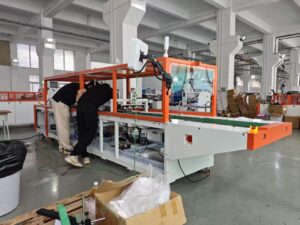
A factory-direct builder controls the design, the tooling, the spare parts stock, and the technical team. That control is what makes a non-standard fold sequence or an unusual bag dimension a solvable problem instead of a refusal.
There is a practical way to test this during evaluation. Ask to see the workshop. Ask which wear parts are produced in-house — conveyor belts, suction cups, sealing blades, mechanical assemblies. Ask who signs off on a custom engineering request. A manufacturer shows you a floor and names the people on it. A trading company shows you a catalogue and changes the subject.
2 Get an after-sales response commitment in writing
Folding equipment is production-critical. When it stops, the packing station behind it stops too, and the cost of that stop scales with how close you are to a dispatch cut-off.
Three things define an after-sales structure worth having:
- ✔ Response time for operational issues. Not “we reply promptly” — a number of hours, stated in a document both sides can hold.
- ✔ Scope of remote support. Slight misalignment, an obstruction clearing a fold arm, an HMI parameter that needs adjusting: these are typically resolved in a video session without anyone travelling.
- ✔ Trigger for an on-site visit. Mechanical failures, damaged sensors, worn drive components — these need hands on the machine, and the supplier should be able to tell you in advance which category a problem falls into.
UBL commits to a 6-hour remote response on operational issues, with field engineers dispatched for mechanical faults that require physical repair.

3 Run a sample trial on your own garments
Any supplier worth working with will put your product through the machine before you commit to an order. This is not a courtesy gesture — it is the only evidence that the machine handles your fabric weight, your garment dimensions, your fold specification, and your bag format.
The variables that decide a folding job are specific. Knitwear behaves differently from woven shirting. A hoodie moves differently from a flat tee.
Suppliers who decline trials and offer only a generic demonstration video are asking you to commit capital on the strength of edited footage.
At UBL, a trial is part of the standard pre-purchase sequence: you send garments, you specify requirements, and the machine runs the complete cycle on video for your review before ordering.
4 Find out where parts sit and how fast they move
Consumable components wear out. Sealing blades blunt, conveyor belts stretch, suction cups lose grip. What matters commercially is not the part — it is the interval between the failure and the replacement.
UBL recommends ordering a consumable parts kit alongside the machine to put high-turnover components on your shelf before they are needed.
5 Check what support exists in your region
If a fault needs a technician on site, the practical questions are concrete: how soon can someone travel to your plant, and what does that trip cost in time and money?
Read more about why after-sales service deserves weight in any equipment decision.
6 Settle delivery, installation, and training terms
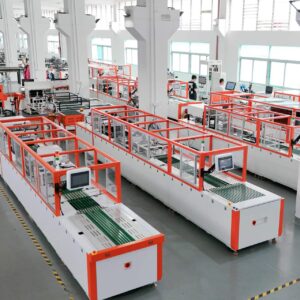
At UBL, installation and calibration are included in the purchase price.
- Custom builds: Approx. 3 months from order to shipment.
- Catalog machines: Leave factory the day after contract is signed.
- Training: 30 mins for basic proficiency; 2-3 days for independent operation.
What the Specification Sheet Does Not Tell You
Specifications describe a machine in a lab. They do not describe your floor. A garment that sits half an inch outside the length range does not fail loudly — it folds slightly off-square, and the labour saving quietly disappears.
Material behaviour
Knitwear stretches and springs back; woven shirting holds a crease. Fabric weight and stretch need separate evaluation.
Garment geometry
Length, width, sleeve position, and hood bulk change how a garment sits on the conveyor.
Pack format
Bag dimension and closure type must allow the garment to enter without manual intervention.
Who Should Be in the Room During Evaluation
Pull all three into the evaluation to ensure long-term success:
- Operations Lead: Focuses on shift patterns and downtime tolerance.
- Engineering/Maintenance: Focuses on electrical supply, air pressure, and height interfaces.
- The Operator: Focuses on bagging ergonomics and HMI usability.
Warning signs during supplier evaluation
| Warning sign | What it usually indicates |
|---|---|
| Declines a sample trial | The machine may not handle your garments reliably |
| No stated response time | Support is informal and potentially slow |
| Cannot supply parts independently | Trading company middle-man adds time and cost |
| Price well below market | Savings coming out of build quality or support |
Questions to put to any supplier
Will you run a trial on our garments before we order? A serious manufacturer answers yes without hesitating.
What is your after-sales response commitment, in writing? Get a specific figure rather than a general assurance.
Where are spare parts held? This determines your exposure when a consumable fails mid-run.
Our semi-automatic clothes folding machine page lists its published capacity of about 400 pieces per hour as a baseline for your comparison.
Where to read next
- Custom Clothes Folding Machine: 5 Signs Your Line Has Outgrown Standard Equipment
- Heavy Garment Folding Automation Guide
- Semi-Automatic Clothes Folding Machine Product Details
Start the evaluation with your own production data
UBL will tell you plainly whether a standard, upgraded, or fully custom configuration fits. Reach the team through our contact page to begin.
Post time: Oct-13-2026